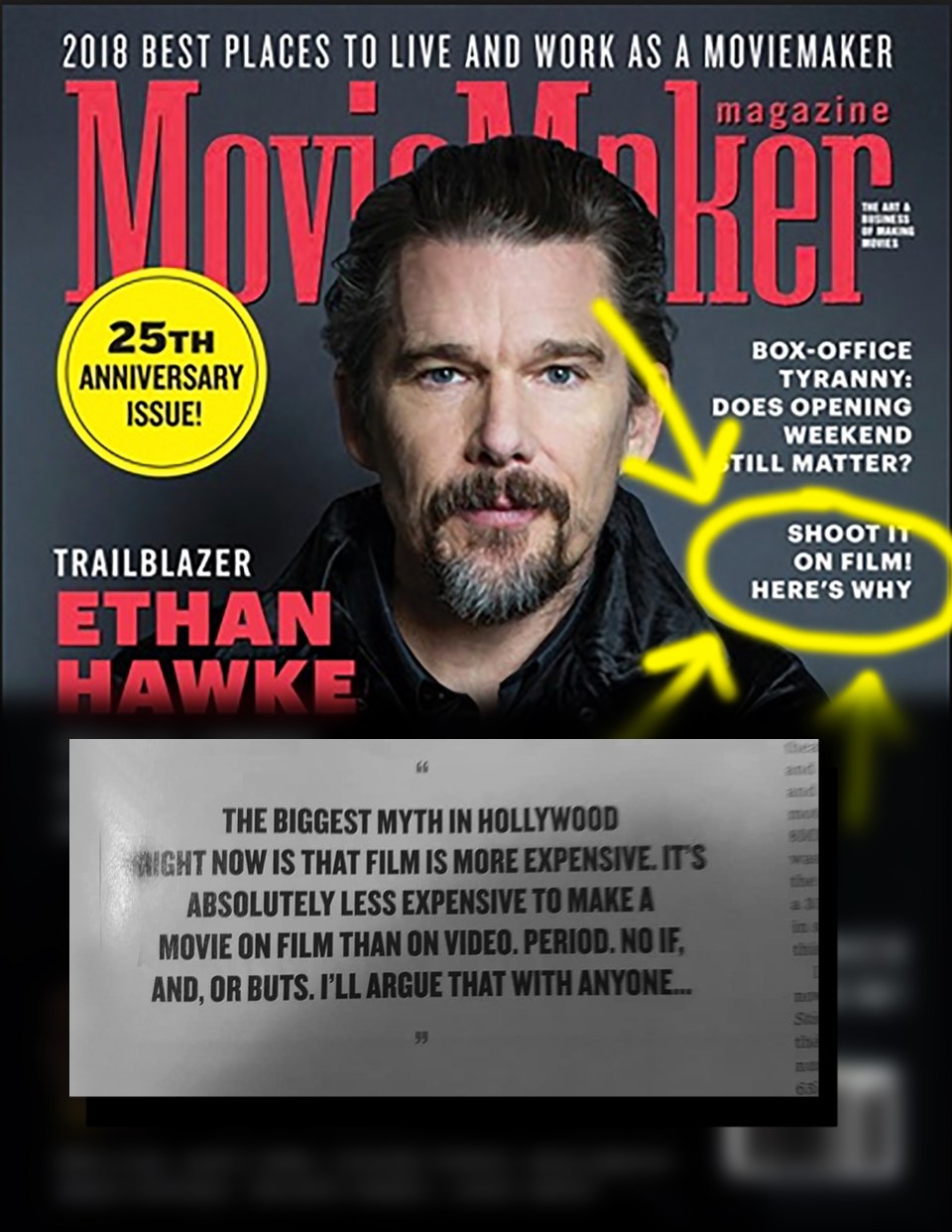
I just readan article in MOVIE MAKER magazine that has my head spinning.
Theres an interview with Steve Bellamy, President of Kodak Film.Bellamy gave a bunch of reasons as to why independent filmmakers should be shooting on film, not digital.
Well, I don’t know any “filmmaker” today who wouldn’t WANT to be shooting on true film. But its too expensive.
Bellamy said “ No one ever said ‘lets make this film look more like digital’“
Well thats true, I do EVERYTHING I can to make my digital footage look “cinematic” Filters, de saturation…..I’ve gotten pretty good at making color digital look like high contrast Black and White, but Im not satisfied with making digital look like color film.
Bellamy said “Film is LESS expensive than digital, no ifs ands or buts”
Well I could give him dozens, if not hundreds of no ifs ands or buts…
He said “camera packages are cheaper with film. Your shooting ratios are lower, your performances are better. People prepare better and storyboard with film— in video they don’t.Film doesn’t have a video village”
He is SO wrongon that.I prep as if it were film. I storyboard. I don’t have a “video village” anyway, my DSLR is used just like a film camera.
He said “When you edit digital, you have four times as much footage to soft through than if you shot film”
He may be right about that, but if I’m editing something I shot myself, I can sift through the footage really fast. In fact some “bad” footage” might capture something I didn’t notice at first.
But of course, his business is selling film.. so of course he’s biased.
I really enjoyed watching this 6o’s documentary on a street gang. Well photographed and edited.
A great time capsule, great recording of the fashions young men wore and the buildings and cars of the era.
BUT!
This stretches the definition of “documentary.” The camera is RIGHT IN THEIR FACES. They knew they were being filmed.
The fights are obviously the boys playing for the camera.
And the shootings, at 16.50. Puh LEASE…. SOOOOO obviously staged. Especially the gang frozen in place and staring as the camera moves across them.. No one poses for the camera in the middle of a crime scene. And no cameraman can get shots THAT good in the middle of a shoot out.
and…. now that I think about it, the boys clearly got especially dressed up and well groomed when they knew they’d be filmed.
They clearly dressed sharp and got their hair groomed especially well when they knew they were being filmed. I doubt they dressed up that well all the time. So sharply dressed to get into a street fight? I am sure the fights were staged, and the shootings seem SO fake and staged.
Not that they weren’t re enacting things they HADN’T already done….. I’m sure they DID get into fights…
Theres not much about this film on the web.
Wikipedia says it was produced by a Temple University film teacher ( Harold Haskins). Presumably this was self produced by him, shot earlier than 1967 ( youtube commenters noted that the boys are wearing fashions and hairstyles from the early to mid 60s, not the late sixties.
Youtube says it was made in 1969, but wikipedia says it was made in 1967. Lets assume it was shot in the mid 60s, finished in the late sixties.
I’d love to hear THIS story:
“Schwartz shared the story of the mighty rise and devastating fall of the gang’s film company as they took the film world by storm for a brief, shining moment before a shocking murder, in-fighting, and drugs dissolved the union. ”
When I was a boy in the early to mid 70s mainstream blacks were never proud to be associated with the street gangs; they were looked upon with pity at best and at worst, they were despised. Now, ironically, they are deified by the mainstream as representing “pure blackness.” Strange”
I replied:
I liked your response and was interested in what you said. As a white man who loves both filmmaking and Black people…. I’ve never understood the glorification of “gangsta” culture that started in the 90s. Most Italians I know get frustrated that ( it seems like) every Italian in movies and TV is some kind of gangster. And many white people dont get that….if the N word is so horrible for us to say why are so many Black folks calling THEMSELVES that?!?!? ( I think I get, its a black peoples word NOW and they’ve reversed it… when black folks say it they mean ” friend”). But so many rappers promoting the gangsta lifestyle, cash, jewelry fancy cars. I see young white men wearing “prison fashion” it baffles me. If a white guy dressed up in “sambo” make up he’d get arrested for inciting a riot. In the later 80s Black leaders were praising the increasing number of TV shows showing healthy successful Black families. There is a conspiracy theory that a bunch of wealthy white media people wanted to invest in private prisons, so they promoted “gangsta” values in the media to keep their prisons full. Sounds like tin foil hat UFO nuttiness….. but maybe not.
Is ‘Three Billboards Outside Ebbing, Missouri’ based on a true story?
There is a critically acclaimed film out now called ‘Three Billboards Outside Ebbing, Missouri’.
You might think it is based on a true story. The writer says it isn’t.
Writer Martin McDonagh says he heard about billboards ( or maybe saw them- the stories vary) somewhere “between Louisiana and Florida” criticizing the local Police about an unsolved homicide.
Well I happen to know that “somewhere between Louisiana and Florida” is a little town called Vidor, Texas.
Vidor, Texas has had a series of billboards on I-10 ( the main highway that leads from Lousiana through Vidor, Beaumont and then onto the mega city of Houston).
Several different billboards were placed on the roadside. The one I saw said
” Welcome to Vidor, Texas where you can get away with murdering a woman! Why? Ask Police Chief _________ ”
A young woman named Kathy Page died under mysterious circumstances in Vidor, Texas in 1991. Her father, James Fulton, is convinced Kathy’s estranged husband (Steven Page) was responsible and he ( Fulton) is outraged that the Vidor Police couldn’t convict him (Page).
He paid for a series of billboards criticizing the Vidor Police.
There is an urban legend that the Vidor Area Ku Klux Klan had posted a billboard on the edge of town saying “N—ger Don’t let the sun set on you in Vidor”. Many people say they remember this sign, and many say there are pictures of it….. but I haven’t seen them (yet).
In the acclaimed documentary ” The Thin Blue Line” one of the characters was from vidor and they show a klan sign nailed to a tree. But its just a plank with the letters “kkk” painted on it. Not really a billboard.
I think many folks who drive past the “Murder a woman” billboard on I- 10 THINK they have seen the infamous Klan sign. But the Kathy Page case has nothing to with racism or the KKK.
I was living in Beaumont, Texas working at a TV station. I can remember all the news stories about the desegregation of nearby Vidor Texas, and the national hoopla when the last African American resident of the Vidor housing complex left and then was killed 12 hours later in a rough neighborhood in Beaumont, Texas.
I spent 5 years researching and shooting an independent documentary on the death of Bill Simpson.
I didn’t find the story I thought I would find. But I told truth as best I could. I really think the movie Three Billboards Outside Ebbing Missouri was at least partially inspired by the Kathy Page case in Vidor Texas.
The billboards at least. The rest of that movie has NO connection to Vidor or the Page case. Its about a mother ( not a father) of a young girl ( in the movie she seems to be between 18 to 20) who frustrated that the local police haven’t found who killed her daughter. Beyond that, there isn’t ANY connection to what happened in Vidor. None of the characters or plot points match up to the Kathy Page case. So the billboards may have been based on the Vidor billboards, but the rest of the story is all fictional.
Here is my documentary. I cover the billboards at: 4.05



 mattkprovideo